Author: Nina Alvarez

  • Expired and FSBO Outreach on Social Media: A Respectful Approach (Lead Generation)

    Expired and FSBO Outreach on Social Media: A Respectful Approach (Lead Generation)

    Maximizing Lead Generation with AI-Powered Real Estate Marketing

    The real estate landscape has dramatically shifted. Generating consistent, qualified leads feels increasingly like a battle against algorithms and established competitors. Traditional marketing methods often yield diminishing returns, leaving many agents struggling to connect with potential clients. But what if there was a way to cut through the noise, reach a wider audience, and nurture leads more effectively? This article explores how AI-powered real estate marketing can transform your approach to lead generation, covering everything from content creation to local SEO and social media automation. We’ll examine the strategies to maximize your online presence and build a thriving real estate business.

    Why AI-Powered Real Estate Marketing Matters

    The State of Real Estate Marketing

    The digital transformation of real estate marketing has been swift. Potential clients are actively searching online for properties and agents across multiple platforms. The competition is fierce. Agents who rely solely on traditional methods often struggle to compete with those who have embraced digital strategies. Consumer expectations have evolved; buyers and sellers expect instant access to information and personalized experiences.

    The Benefits of AI-Powered Marketing

    Artificial intelligence is rapidly changing how businesses operate. AI-powered marketing tools offer benefits like automating repetitive tasks (social media posting, content creation) and analyzing data to identify trends and personalize marketing messages. For example, AI can analyze website traffic to identify content that resonates with potential clients. This can level the playing field, allowing smaller agencies to compete with larger firms. Data from 2025 indicates that agents utilizing AI-driven tools experienced a 23% increase in lead generation compared to those relying on traditional methods.

    Creating Engaging Real Estate Content with AI

    The Power of Video in Real Estate Marketing

    Video has become an indispensable tool for real estate agents. Potential buyers and sellers are drawn to visually compelling content. High-quality videos create an emotional connection and showcase properties and neighborhoods. Advancements in AI technology have made it easier and more affordable to produce engaging real estate videos.

    Creating Engaging

    Photo by Quixess Social

    Leveraging Social Media for Lead Generation

    Social media remains vital for real estate lead generation. To connect with potential clients, agents need to create engaging content that provides value and fosters a sense of community. Sharing neighborhood guides, market updates, or tips for first-time homebuyers builds relationships. Remember that many potential clients are actively researching agents online, so a strong social media presence can significantly impact their perception of your brand. 5 Buyer Signals Hiding in Your Local Facebook and Nextdoor Groups.

    Maximizing Local SEO for Real Estate Agents

    The Importance of Keyword Research

    Local SEO is crucial for attracting clients in your service area. Ranking high for searches like “real estate agent near me” requires a strategic approach to keyword research and website optimization. Keyword research involves identifying terms potential clients use to search for real estate services. Data from 2025 indicates that agents who actively optimize their websites for local SEO experience a 38% increase in organic traffic.

    Man standing amidst vibrant plush toys at a market in Dharamshala, India.

    Photo by Swapnil RK on Pexels

    Optimizing Your Website for Local Search

    Optimizing your website involves ensuring it’s technically sound, mobile-friendly, and user-friendly. Building local citations and encouraging clients to leave online reviews can improve your local search ranking. How to Write a Neighborhood Guide That Ranks on Google.

    Automating Social Media Scheduling for Real Estate Agents

    The Benefits of Automated Scheduling

    Time is valuable for real estate professionals. Juggling client meetings and marketing efforts leaves little room for anything else. Automated social media scheduling offers a solution. By pre-planning and scheduling posts, agents can reclaim valuable time to focus on core business activities. Consistent posting maintains relevance in algorithms, increasing visibility and reach. QuixAgents provides a streamlined process for content creation and distribution.

    Automating Social

    Photo by Quixess Social

    How to Get Started with Quixess Copilot

    Getting started with automated social media scheduling is straightforward. Begin by identifying your target audience and the platforms they frequent most. Batch content creation to improve efficiency. Consider using a scheduling tool’s built-in analytics to track post performance and refine your strategy. For agents looking for a more comprehensive solution, see how the platform can streamline your entire marketing workflow.

    Measuring the Success of Your Real Estate Marketing Strategy

    The Importance of Tracking Engagement Metrics

    Tracking engagement metrics, likes, shares, comments, click-through rates, and website traffic, provides valuable insights into what’s working. Analyzing these metrics helps you understand which platforms drive the most traffic and leads. For more insights into lead generation, check out our guide on “Reddit for Real Estate Agents: Answering Questions in Local Communities.”

    relaxing by the fireplace

    How to Use Data to Optimize Your Marketing

    Data-driven decision-making is crucial. Regularly review your engagement metrics and identify trends. Use this information to refine your content strategy and optimize your posting schedule. Many social media platforms offer built-in analytics dashboards. In 2025, a survey of real estate professionals found that those who actively tracked and analyzed their marketing data experienced a 15% increase in lead generation compared to those who didn’t.

    Conclusion

    Maximizing lead generation demands a strategic and data-driven approach. Automating social media scheduling and tracking engagement metrics provide a roadmap for success. Remember that consistency and adaptability are key; continuously monitor your performance, refine your tactics, and embrace new technologies. Start implementing AI-powered real estate marketing strategies today to maximize lead generation and elevate your business.

  • How to Market a Listing That Has Been Sitting Too Long (Listing Marketing)

    How to Market a Listing That Has Been Sitting Too Long (Listing Marketing)

    How to Market a Listing That Has Been Sitting Too Long: A Multi-Channel Strategy

    A listing that sits on the market for months sends a powerful signal to buyers: something is wrong. Whether it’s the home itself or a missed marketing strategy, stale listings carry psychological weight that price cuts alone cannot overcome. This guide walks you through a multi-channel strategy that repositions stale listings through fresh video content, local search authority, and automated cross-platform presence.

    Why Stale Listings Lose Momentum, and How to Restart It

    The Psychology of Days-on-Market

    Buyer perception shifts dramatically after a listing reaches 30-60 days on the market. Research shows homes lingering beyond this window carry a stigma. Buyers start asking: Why hasn’t this sold? Is there structural damage? The longer a home sits, the more scrutiny it faces and negotiating power shifts to buyers.

    The first 30 days generate the majority of serious inquiries. After that window closes, traffic drops sharply even if the property remains competitively priced. Price reductions don’t reach new buyers; they reinforce the perception that the home is undesirable. The solution is repositioning through fresh creative and new audience reach.

    Rebuild Appeal with Video Content That Speaks to Today’s Buyer

    Video Formats That Perform When Static Photos Have Already Failed

    Buyers scrolling social feeds ignore static images, especially if they’ve already seen them during the listing’s initial launch. Vertical video formats like Reels, Shorts, and TikTok reach younger buyer pools and first-time buyers who may not have engaged with the original listing push.

    real estate video production

    Photo by Quixess Social

    A fresh 30-second listing video resets the “new listing” feel, even though the home has been on market for months. Visual movement, music, and narrative framing create emotional connection that static posts cannot replicate.

    Tools That Turn Existing Listing Photos Into Scroll-Stopping Content

    Automated real estate video creation tools transform photo galleries into polished walkthroughs with motion, music, and overlays in minutes. QuixAgents turns existing listing photos into videos without requiring drone footage or professional editing, delivering ready-to-post vertical videos optimized for each social channel.

    This matters for stale listings because speed is critical. You don’t have time to reshoot; you need new assets live within days. A 15-photo listing becomes five different 30-second videos highlighting the kitchen, primary suite, outdoor space, walkthrough tour, and neighborhood context, each reaching different buyer segments.

    Claim Local Search Authority to Put Your Listing Back in Front

    Local SEO as a Listing Revitalization Tool

    Stale listings often remain invisible in local search because agents haven’t invested in building neighborhood authority. When a property sits longer than expected, new buyers still search for neighborhoods. A buyer typing “homes for sale in Riverside” needs to find your content, and your listing should appear alongside it.

    blue pushpin on map

    Local SEO blog content repositions your listing as part of a larger market narrative. Publishing neighborhood guides signals to Google that your agency understands that area, building authority that keeps listings visible during slower sales cycles.

    Neighborhood Content That Ranks and Drives Qualified Traffic

    Create a comprehensive neighborhood guide for the area where your stale listing sits, optimized for local search intent. When that guide ranks, buyers researching the area land on your content first, see your listing featured, and engage with your market knowledge.

    For example, a guide titled “The Complete Guide to Riverside: Schools, Parks, and Neighborhood Character” targets buyers searching for community information. QuixAgents can generate these guides from property data and neighborhood details, ensuring they’re optimized for Google ranking. Publishing this content establishes your listing within a broader market context, shifting perception from “this house has been sitting” to “this is an active listing in a neighborhood I’m an expert in.”

    Automate Your Presence Across Every Channel Without Burning Out

    The Cost of Manual Social Media Scheduling

    Relaunching a stale listing demands consistent posting across Instagram, Facebook, TikTok, and YouTube. Manual scheduling consumes hours every week. For most agents juggling multiple listings, this becomes a bottleneck. An agent earning $100,000 annually spends roughly $50 per hour on administrative work. Four hours weekly on manual social scheduling costs $10,000 per year in lost productivity.

    real estate agent social media

    Photo by Quixess Social

    How Agents Scale Consistent Posting Without the Admin Work

    Automated social media scheduling tools designed for real estate allow agents to plan multi-platform campaigns from a single dashboard. Once video and blog content are created, batch-create posts, set publication dates across all channels, and let automation handle distribution. Consistent, daily visibility rebuilds momentum and signals to algorithms that the listing is actively marketed.

    Sporadic viral posts generate noise; consistent posting over weeks generates algorithm trust and buyer familiarity. A stale listing needs sustained visibility more than flashy one-off content. Automation ensures every piece of newly created content reaches maximum audience without requiring daily manual effort.

    Conclusion

    A stale listing demands a complete marketing restart, not merely a price reduction. Video content breathes new life into tired imagery and reaches buyers scrolling social platforms. Local SEO blog posts establish market authority and bring qualified traffic directly to your listing. Automated scheduling ensures this renewed creative effort sustains momentum every day.

    The combination of video creation, neighborhood content generation, and multi-channel automation allows agents to reposition listings faster and more professionally. Agents who move quickly with fresh creative assets and expanded search visibility can recover momentum and reach buyers who missed the initial launch window.

    Start today: Identify your longest-sitting listing, create a 60-second property video, publish a neighborhood guide optimized for local search, and schedule a two-week content plan across your social channels.

  • Coming Soon Campaigns: How to Build Buzz Before a Home Hits the Market (Listing Marketing)

    Coming Soon Campaigns: How to Build Buzz Before a Home Hits the Market (Listing Marketing)

    Coming Soon Campaigns: How to Build Buzz Before a Home Hits the Market

    The pre-listing phase is when most agents lose critical marketing momentum. Coming soon campaigns create anticipation, build exclusivity, and capture high-intent buyers before your listing officially hits the market. This guide reveals strategies top-producing agents use to generate buyer inquiries from day one.

    Why Coming Soon Marketing Matters More Than Ever

    The window before ‘active’ is your competitive advantage

    The coming soon phase creates scarcity and exclusivity. Buyers who discover a property before official launch feel they’ve found an insider opportunity, translating emotional advantage into faster engagement. Research from the National Association of Realtors indicates that 73% of today’s buyers begin their search online.

    How early visibility affects final sale price

    Agents who invest in coming soon campaigns report 10-15% faster closing timelines compared to those who wait until active listing day. A property attracting 15 qualified buyers in the pre-listing phase enters active status with documented demand, strengthening your negotiating position.

    Video Content Strategy for Coming Soon Listings

    Turning pre-listing photos into scroll-stopping previews

    Video dominates real estate content. Instagram Reels, TikTok, and YouTube Shorts account for over 60% of real estate content consumption among buyers. Convert existing pre-listing photos into dynamic video teasers that capture attention within two seconds.

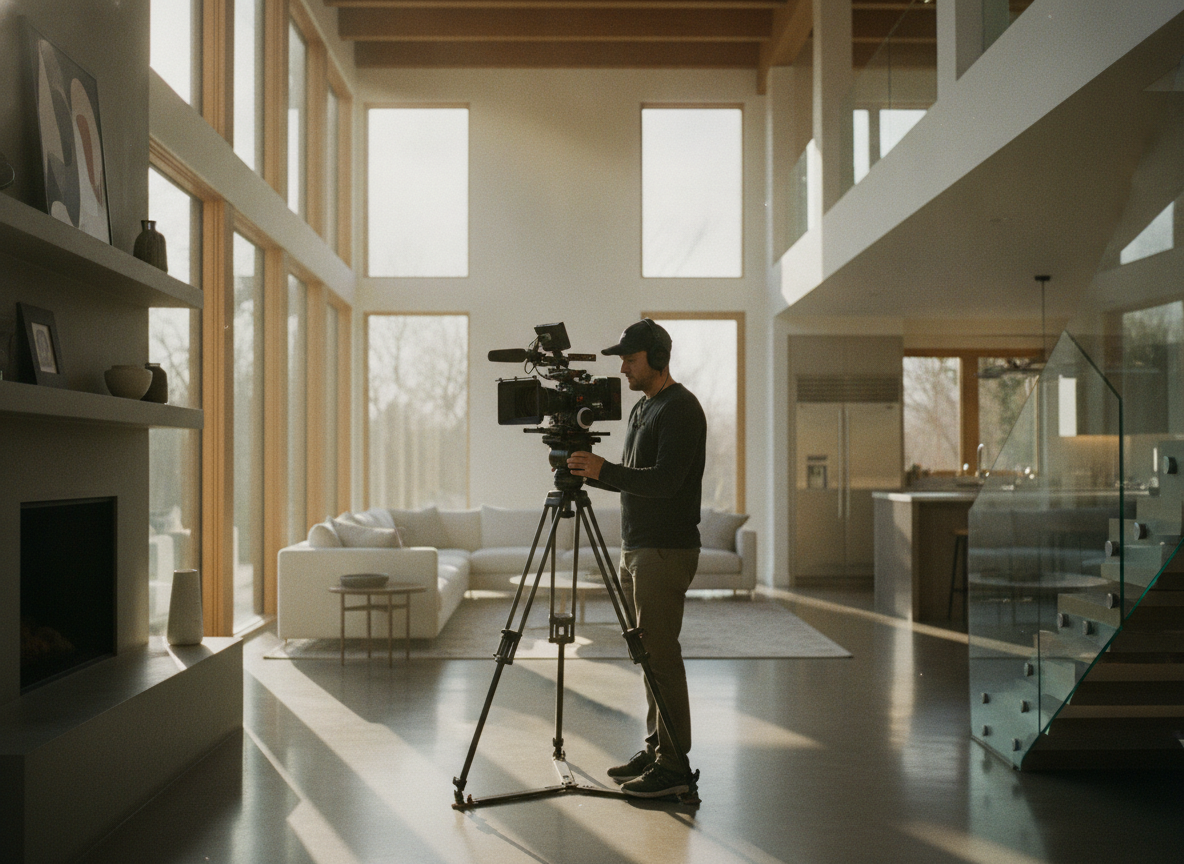
    real estate video production camera

    Photo by Quixess Social

    Focus on teaser content rather than full reveals. A 15-second clip highlighting architectural details, premium finishes, or neighborhood walkability outperforms longer walkthroughs. Partial reveals drive higher engagement because viewers must engage further to see the complete picture.

    Where to distribute coming soon video clips

    Success depends on multi-platform distribution with platform-specific optimization. Adapt a single vertical video for Instagram Reels, Facebook Reels, TikTok, YouTube Shorts, and LinkedIn. Each platform favors different patterns: Instagram rewards consistent posting within 6-hour windows, TikTok prioritizes trending sounds and hashtags, and YouTube Shorts benefit from 15-60 second durations with text overlays.

    QuixAgents enables agents to automate multi-platform distribution through scheduled posting that maintains optimal timing across channels.

    Timing and frequency that builds anticipation

    Coming soon campaigns perform best on a 3-5 post-per-week cadence. Tuesday-Thursday evenings at 6-8 PM typically generate highest engagement. Countdown elements amplify anticipation with text overlays like “Coming This Friday.” Layer multiple content types, architectural detail videos one day, neighborhood features another, seller-favorite room reveals on a third, rather than repeating the same property from different angles.

    Content Formats That Generate Buyer Inquiries Before Day One

    Neighborhood spotlights that position the property within market context

    Position coming soon listings within a compelling neighborhood narrative. Create content answering “What’s it really like to live here?” with posts about local amenities, school district performance, walkability scores, and lifestyle factors aligned with your target buyer persona.

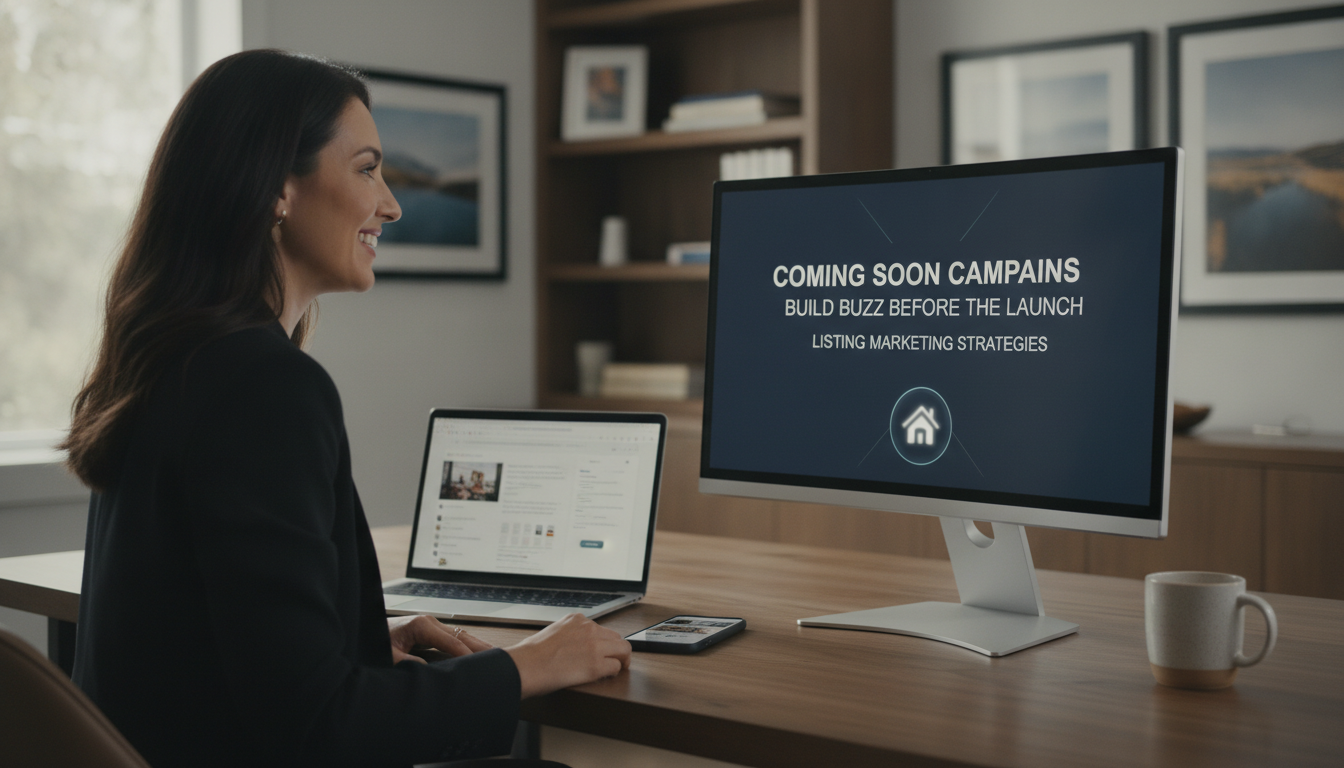
    smiling real estate agent

    These spotlights work best as SEO-optimized blog posts. A post titled “Where Young Families Are Moving in [Neighborhood]: 2026 Market Insights” naturally incorporates the coming soon property into broader community story while ranking for high-intent searches.

    Market data posts that attract serious buyers

    Data-driven content filters for serious buyers. Include market updates addressing buyer concerns: inventory levels, price trends, days-on-market benchmarks, and comparative analysis. According to the National Association of Realtors, 72% of buyers research neighborhood market conditions before contacting an agent. Posts answering “How competitive is this market?” or “What are homes actually selling for in this area?” attract ready-to-buy searchers with concrete data: median sale prices from the last 90 days, average days-on-market for similar properties, inventory trends, and price-per-square-foot comparisons.

    AI-Powered Real Estate Marketing: Scaling Coming Soon Campaigns Without Manual Work

    Automating the coming soon content calendar

    QuixAgents allows agents to upload listing photos once and generate videos, graphics, blog posts, and social-ready content in minutes. The platform uses AI to recognize room types, generate SEO-optimized captions, and create format-specific variations. A coming soon campaign requiring 8-12 hours of manual work now takes 90 minutes from photo upload to multi-channel publishing.

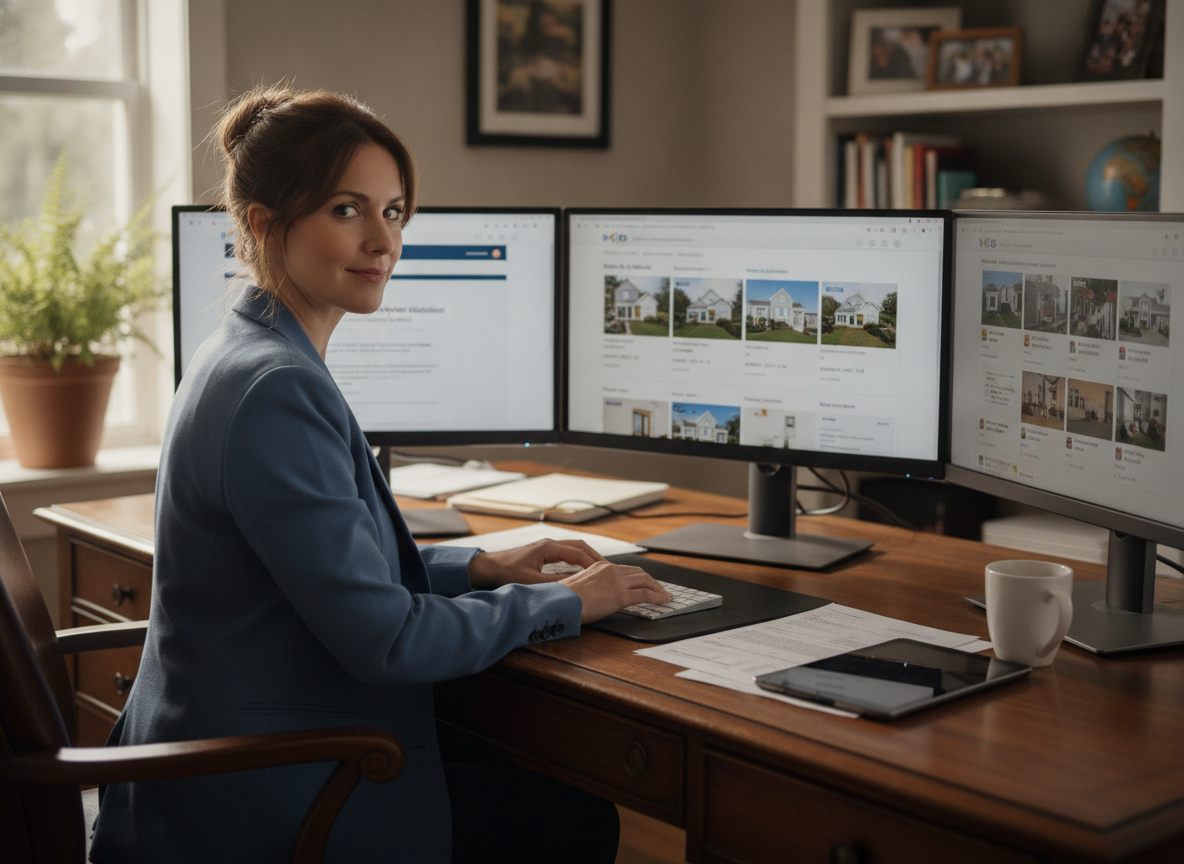
    real estate agent computer analytics

    Photo by Quixess Social

    Finding and reaching buyers before they contact competitors

    65% of home searches now begin on social platforms rather than traditional real estate sites. AI-powered monitoring identifies buyer signals in local communities: Nextdoor conversations about relocations, Facebook group questions about school districts, Reddit threads about moving to specific areas. A prospect asking “Where should we move for a good school district?” becomes a warm lead for the coming soon property in that exact district.

    Repurposing one listing into multiple campaign assets

    One listing generates a coming soon video, property blog post, neighborhood guide, market update, daily social posts across platforms, email newsletters, and community announcements from the same photos and information. A video is sliced into short-form clips for TikTok and Reels. Property highlights become social graphics. Neighborhood research becomes blog content. Market data becomes email snippets. Agents publish 40-50 pieces of content during a two-week coming soon phase without creating individual assets, reclaiming 5-10 hours per week.

    Conclusion

    Coming soon campaigns are essential in today’s competitive real estate market. The weeks before a property officially launches are the most valuable marketing window available. Success requires consistent, multi-format content across video, blog, and social channels paired with strategic timing that reaches ready-to-move buyers before competitors. Agents leveraging AI-powered tools to automate video creation, SEO blogging, and social scheduling win more listings, generate pre-listing offers, and close faster.

  • How to Write a Neighborhood Guide That Ranks on Google

    How to Write a Neighborhood Guide That Ranks on Google

    If I could give every agent one piece of content advice, it would be this: write neighborhood guides. People searching for “living in” a specific area are often months into planning a move, and a guide that answers their questions puts your name in front of them early.

    Unlike social posts, a good guide keeps working. It can bring visitors to your website long after you publish it.

    Choose the right neighborhood and keyword

    Start with areas you know well and want to be known for. Then think about how people actually search. Phrases like “moving to [neighborhood],” “living in [neighborhood],” and “[neighborhood] homes for sale” are a good starting point. Use your main phrase in the title, the first paragraph, and at least one subheading.

    A structure that works

    1. A quick overview: where the neighborhood is and what it is known for, in two or three sentences
    2. Housing styles and price ranges: the types of homes buyers will find
    3. Getting around: commute routes, public transit, walkability
    4. Parks and recreation: trails, playgrounds, sports facilities, community centers
    5. Food, shopping, and entertainment: local favorites and new openings
    6. Schools: the districts that serve the area, with links to official sources
    7. Frequently asked questions: short answers to the questions clients ask you most

    Show local knowledge nobody else has

    Search engines increasingly reward first-hand experience, and that is your advantage over big listing portals. Include details only a local agent would know: the farmers market that runs on Saturdays, the street that backs up during school pickup, the new greenway extension. Add photos you took yourself whenever you can.

    Keep the language fair housing friendly

    Neighborhood content is where agents most often slip on fair housing, usually without meaning to. A few habits keep you on solid ground:

    • Describe places, not people. Talk about parks, restaurants, and amenities rather than who lives in the area.
    • Avoid words like “safe,” “family-friendly,” or “exclusive.” Point readers to official crime data or school district sites so they can decide for themselves.
    • Stick to facts you can verify, and link to the source when you cite data.

    Check your brokerage’s guidelines too, since many have specific advertising rules.

    Handle the SEO basics

    Give the post a clear title under about 60 characters, write a meta description that promises what the guide delivers, use descriptive subheadings, and add alt text to your images. Link the guide to your related market updates and listings so readers have somewhere to go next.

    Update it every year

    New restaurants open, roads change, and prices move. Refreshing your guide once a year keeps it accurate and signals to search engines that the content is current.

    Publishing without the busywork

    QuixAgents includes a neighborhood guide template that fills in your market automatically, writes the SEO title, meta description, and focus keyword, and publishes directly to your WordPress site with Yoast checks in mind. You add the local insight only you have.

    One strong guide per neighborhood you serve is one of the best long-term marketing investments an agent can make.